

When Age Is a Benefit
Strength shaped by experience, anchored in faith.

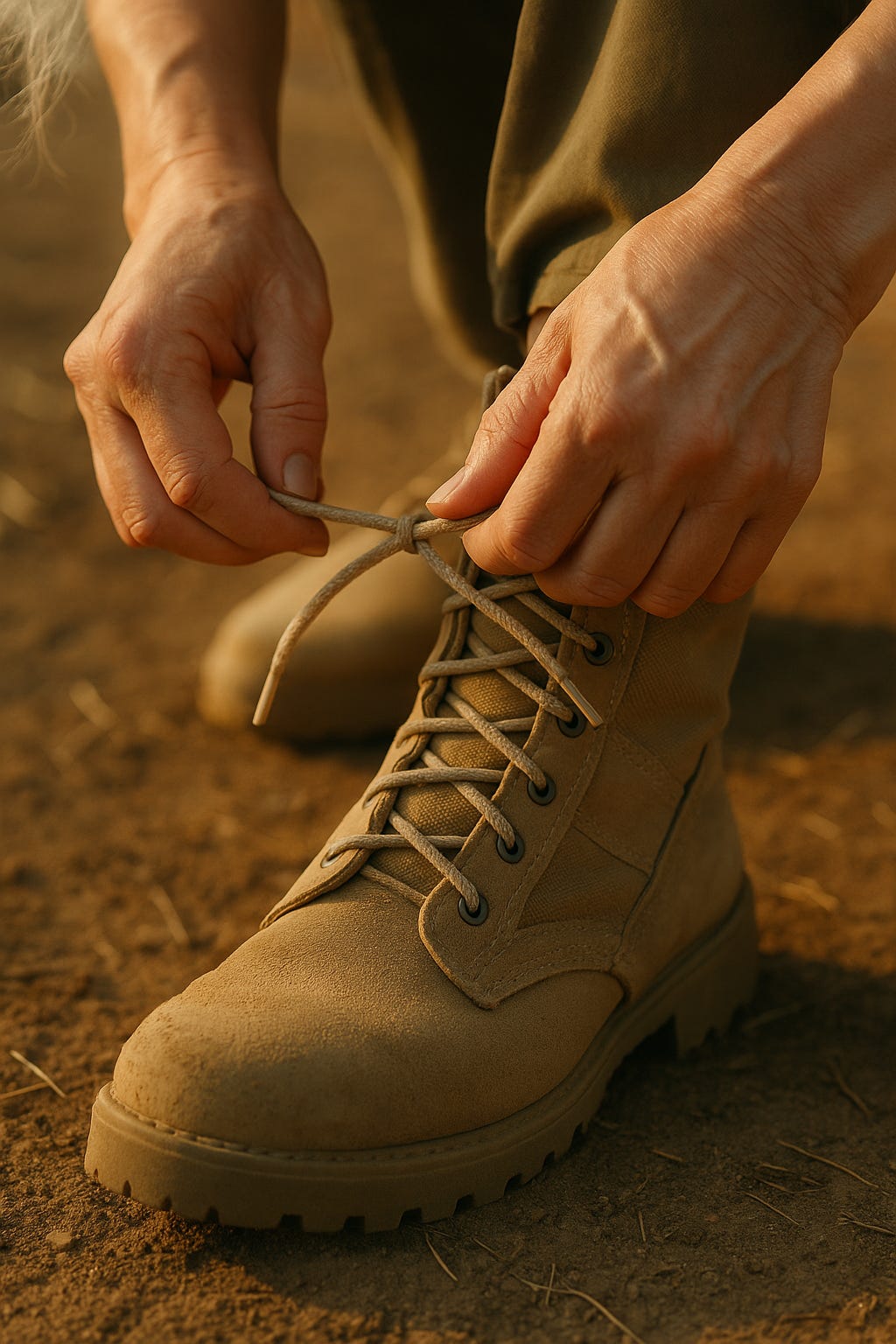
Strength doesn’t always roar. Sometimes, it shows up quietly — in steady hands that keep lacing up and moving forward.
At the ripe old age of twenty-five, I was one of the “grandmoms” of my Marine platoon. Most of the other women were 18 to 20 years old.
Of course, it didn’t help that I had a full head of gray-silvish hair. The younger recruits looked at us and thought, “What were they thinking? How do the grandmoms believe they’re going to keep up with the youngsters?”
Would it surprise you if I told you that, for the most part, it was the other way around?
Most of them came straight from high school. Some were athletic and had participated in sports. The vast majority hadn’t. One of the problems young people face is that they think they know everything. Boot camp had other plans.
I didn’t consider myself old at twenty-five, but I did have a few years of real-world experience under my belt, and that made all the difference.
Most of us sell ourselves short. We think some things are out of our reach for one reason or another.
I had a burning desire to be a Marine. Were the odds stacked against me? Absolutely. But I wasn’t willing to give up before I even tried. I ignored what most of the other services said I couldn’t do. The Marines were the only ones who told me what my possibilities were.
Once I got the chance, I wasn’t about to blow it—no matter what it took to reach the goal. Don’t get me wrong—there were days I wanted to give up. But when those thoughts crept in, I went back to my stronghold: Jesus. He’s the one who got me through—and helped me thrive in the experience. Without Him, I would have given up long before graduation.
For some, the classes and studying were hard. They thought they’d finished all that when they left high school. I’m a sponge when it comes to learning. I love to read, and new knowledge draws me in like a magnet. The other grandmom and I approached boot camp with open minds, ready to absorb everything our instructors had to teach us.
Then, of course, there was the physical side—PT, drills, obstacle courses, and humps, depending on the training schedule. I had some trouble with the physical demands; I won’t lie. But I was willing to push through it, realizing I had to reach the goal no matter what it took.
When we ran our mile and a half, most of the younger recruits struggled. I had an unexpected advantage: I was at the back of the formation. While the long-legged recruits up front basically walked everywhere, those of us in the back had to run just to keep up.
What could have been a disadvantage built my endurance for the running tests. I recognized it for what it was and used it. That’s the difference experience makes—you learn to spot opportunities even in difficult circumstances.
My definition of camping and the Marines’ were definitely not the same. However, I grew up camping in tents and out in the open—experience that proved invaluable during our field exercises. This part didn’t bother me, unlike most of the rest of the platoon.
I remember one tactical exercise where we were in the field for a few days using two-man tents. The other grandmom and I shared a tent, which everyone thought was funny. Honestly, we didn’t care. It actually gave us a breather from trying to lead the younger ones. Some appreciated what we were trying to teach; others, well, they knew it all.
Then, in the middle of the night, everything changed. Our sleeping area was flooding. Everyone had to grab their gear and move into a nearby building immediately. The water was rising fast, and some of the recruits’ gear was already floating away in the dark. It’s one thing to be rudely awakened; it’s another to add an urgent situation you have to deal with half-asleep, with water rising around you.
For a split second, I froze too—the water was cold, boots sloshing, adrenaline high—but instinct kicked in. Years of life had already taught me: panic never helps. You breathe, you move, you lead.
A lot of the younger women were scared and unsure what to do. They froze or panicked. The two of us stepped in, staying calm and helping coordinate the transition to the new location. We’d been through enough unexpected situations in life to know that panic never helps—you assess, you act, you adapt. That night showed why our age and experience mattered.
What I found interesting was that both of us older recruits graduated, while the majority of the young ones didn’t. Maybe it was because we were open to listening and learning. Or because we’d already learned that we didn’t know everything.
Don’t write someone off because of their age. You have no clue what they’ve lived through to get there.
Experience doesn’t shout; it steadies. And sometimes, the calmest voice in the storm is the one that’s already weathered a few.
Thank you for a wonderful and insightful article. Many of our younger citizens rely totally on their phones and have not honed their minds to think without them. They have none of the experiences that we have lived. The world has changed so very much over the last 75 years.