
Before It’s Too Late
It's not the big moments—but the quiet neglect—that causes the most significant loss

Just because you don’t take the time to look doesn’t mean something isn’t there.
How many times have you ignored the same object without noticing it?
I know I have, too many times to count. But just because we don’t stop to see it doesn’t mean it doesn’t exist.
Last week, I walked past the same tree on my street for months—maybe years—until I finally looked up one morning. Looked. It was covered in tiny white blossoms I had never seen before.
Had they always been there? How many springs had I missed seeing them bloom, then fade, as I hurried past with my head down and my mind elsewhere?
We're creatures of habit, focused and task-driven. Amid all that pushing forward, we forget to look around.
When was the last time you stopped to notice what—or who—was around you?
Did something catch you off guard? Has it always been there, and you never noticed?
We are often too busy to notice small details—the things that might be most important. However, we overlook their significance because they don't align with what we're doing or planning.
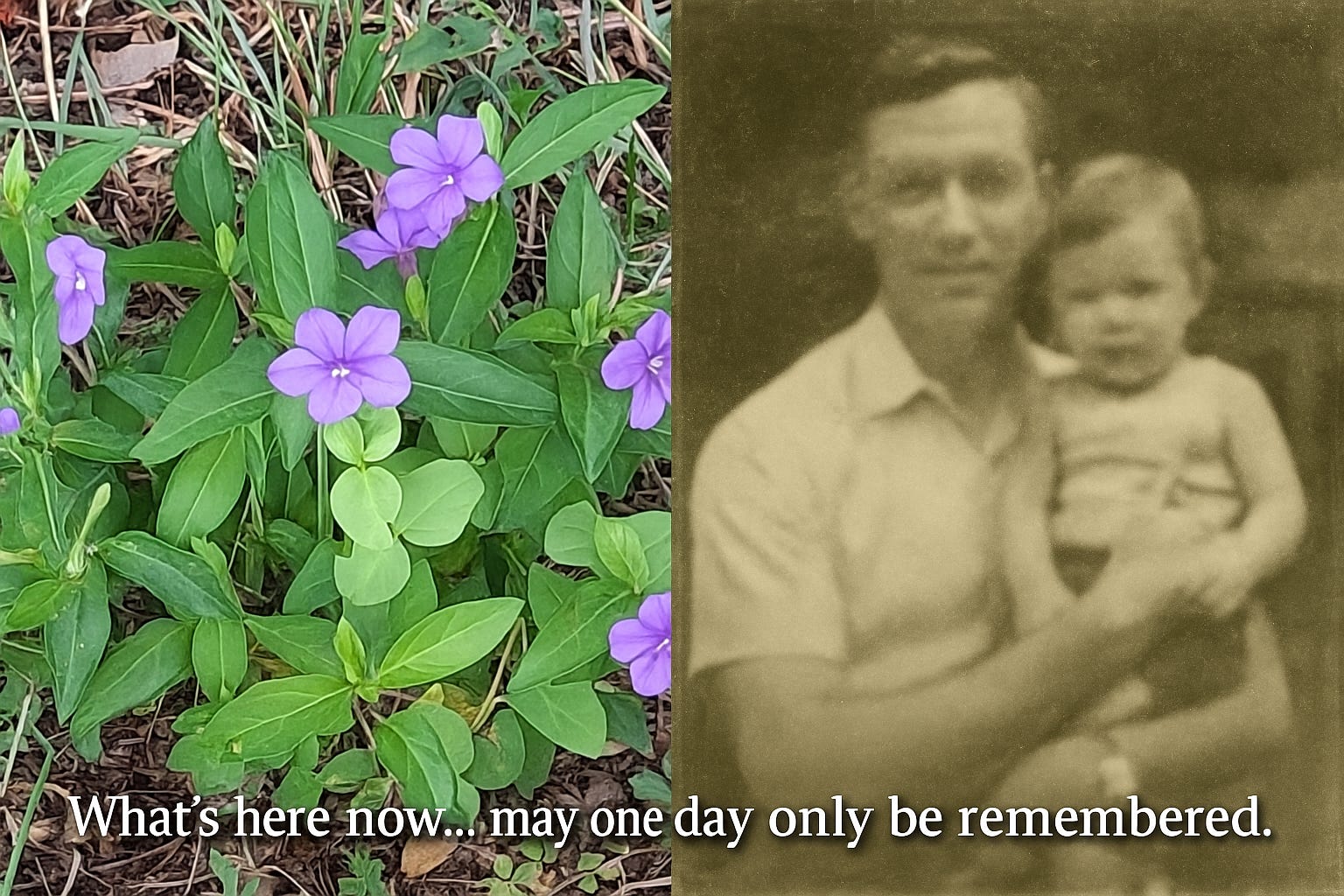
It might be something as simple as a flower or something much more important... a loved one.
Most of the time, we don't recognize what we've lost until it's gone. And it doesn't happen instantly.
It's a slow fade.
This truth reminds me of that old children's song: "Be careful little eyes what you see..." But there's another song that captures this even better—"Slow Fade" by Casting Crowns: "It's a slow fade when you give yourself away... people never crumble in a day."
Gradually, we stop noticing. We become numb. It becomes our new normal.
We cease talking to our spouses or significant others. We miss time with our children until they grow up and leave home. Family members drift apart—or worse, they pass away. The animals and flowers we once took for granted quietly disappear—some forever gone, extinct, endangered, or lost.
We assume they'll always be there when we're ready to reconnect.
But by then, it's already too late.
Spouses or significant others have moved on because they felt invisible. Children have grown up, moved out, and started lives we no longer fully know. Family members have moved or passed away while we were "too busy." Species vanish. Flowers bloom their last. And we weren't even looking.
What will it take for us to pause and observe?
An illness? An accident? A divorce? A death?
Where is your line in the sand? When is enough... enough?
When will we stop pretending that work is the ultimate goal?
When will we finally find the time to see and genuinely care about the people, animals, and the world that mean the most to us?
Maybe noticing begins small. Perhaps it's as simple as looking up from our phones when someone speaks to us or truly listening when our child shares about their day, even if we've heard a hundred similar stories.
Maybe it's sitting with our coffee for five extra minutes in the morning, genuinely watching the sunrise instead of scrolling through emails.
Maybe it's about choosing to see what has always been there.
Before it's too late.